Groundwater Tools
UC Davis Logo
UC Davis Logo
Site Logo

Groundwater Tools

Main navigation (extended config)
  • Home
  • Research
    • A groundwater nonpoint source pollution modeling framework to evaluate long‐term dynamics of pollutant exceedance probabilities in wells and other discharge locations
    • Demonstrating the potential for using nutrient management and/or agricultural managed aquifer recharge (Ag-MAR) in the source area of a public supply well to remediate nitrate contamination
    • Developing statistically based metrics of nonpoint source groundwater contamination and assessing the role of aquifer heterogeneity versus pumping rate and well depth on these metrics
    • Developing the mSim software using a suite of Matlab functions for simulating nonpoint source (NPS) pollution in groundwater aquifers at high resolution over hundreds of years
    • Effects of upscaling temporal resolution on groundwater nitrate transport model performance at the regional management scale
    • Evaluating computational methods (here: algebraic multigrid preconditioners) to address the computational demands in groundwater nonpoint source pollution transport models
    • Nonpoint source (NPS) pollution of groundwater: What is the impact of aquifer, soil, and land use spatial variability on our ability to predict future nitrate, salt concentrations
    • Nonpoint source (NPS) pollution of groundwater: what time scales matter when we design a groundwater flow and transport model to assess nitrate or salt transport?
    • Putting the NPSAT modeling framework to test: comparison to a fully three-dimensional, transient model of nitrate transport in the northeastern San Joaquin Valley
    • Simulation of unconfined aquifer based on adaptive mesh refinement
    • Theoretical background and validation of a simple online tool to obtain statistical estimates of future nitrate outcomes at public supply wells, following a user-defined change in land use or land management
    • Tule River
  • Software
    • ICHNOS
    • Mantis
    • Mantis/NPSAT Web Interface
    • NPSAT engine
    • Stochastic Assessment for NPS contamination
    • mSim
  • Publications
  • People
A groundwater monitoring well, surrounded by four yellow protective columns, located in an almond orchard that is in full spring blossom. The site depicted is used for research on nutrient management in farms and how fertilizer use affects groundwater quality, especially groundwater nitrate.

Nonpoint Source Pollution and Age Tracer Assesment across Landscapes

The Nonpoint Source Assessment Toolbox (NPSAT) is a groundwater modeling framework designed to evaluate the fate and transport of nonpoint source (NPS) contaminants such as nitrate and salts, but also the fate of age tracers that leach into groundwater from agricultural, urban, and natural land uses. The primary application of NPSAT is to assess groundwater quality in irrigation, public, and domestic supply wells.  We provide detailed information on our NPSAT research applications and available NPSAT software and online tools, including online mapping tools.

The NPSAT framework – in contrast to other groundwater flow and transport models -  is designed specifically (a) for high-resolution nonpoint source contaminant transport across entire groundwater (sub)basins and (b) to facilitate “on-the-fly” evaluation of dozens, hundreds, or thousands of different user-designed nonpoint source contaminant leaching future scenarios. These scenarios represent user-selected application of alternative source management practices associated with user-selected specific land uses and/or crops.

Autumn landscape with a winding river, colorful trees, and mountains under a partly cloudy sky. The photo was taken by Thomas Harter in Scott Valley, Siskiyou County, California, USA.

Groundwater-Surface Water Interaction: Integrated Modeling & Monitoring to Inform Groundwater Sustainability Plans

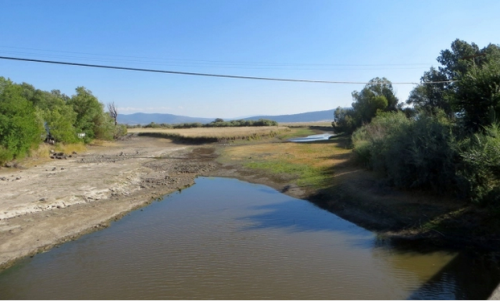
The reduction and depletion of stream flow and lake levels due to groundwater pumping is an underappreciated impact of groundwater pumping with often devastating effects on ecosystems. California’s new groundwater law (the 2014 Sustainable Groundwater Management Act, SGMA) is one of few state and international water laws that explicitly attempt to protect “interconnected surface waters”. We have been developing novel integrated hydrologic modeling approaches to provide decision-support to local, regional, and state regulatory agencies.  Developing these decision-support tools has been a two-step process: development of a trusted baseline model capable of reproducing and explaining the observed hydrologic history; and development of future model scenarios to inform decision-making.  This provides the basis for the design of appropriate and effective monitoring networks, for prioritizing potential future projects and management actions, and for setting regulatory limits on groundwater-surface water interaction. The modeling development is part of a transdisciplinary collaboratory with a wide diversity of outreach and extension efforts with the affected community’s various actors.  Through their interactions with these models, they participate in the design of the model.

just a test image

Learning About Groundwater in Agricultural Regions

Scientists and engineers in academia, consulting, and in agencies use a wide range of groundwater modeling software to simulate, understand, and predict the behavior of groundwater and of contaminants traveling in groundwater.  Much of our research, outreach, and Cooperative Extension work at UC Davis is focused on the nexus between groundwater and agriculture - both, with respect to water quality, to water supply, and to groundwater-dependent ecosystems.  We develop and use a multitude of computational tools and often detailed, real world monitoring and reconnaissance data. Our tools build on sophisticated open-source software and we take pride in being transparent and "open" with respect to our own software and the data we use.

Our goal is to research, learn, and inform about the groundwater-agriculture nexus. As part of or mission, we here provide our data, software, as well as our intuitive online learning tools to be empoyed by other scientists and engineers, by  water managers, by stakeholders at the agriculture-groundwater nexus, and by the interested public.


Site Logo
Groundwater Tools
UC Davis footer logo

University of California, Davis, One Shields Avenue, Davis, CA 95616 | 530-752-1011

  • Questions or comments?
  • Privacy & Accessibility
  • Principles of Community
  • University of California
  • Sitemap
  • Last update: March 26, 2026

Copyright © The Regents of the University of California, Davis campus. All rights reserved.

This site is officially grown in SiteFarm.